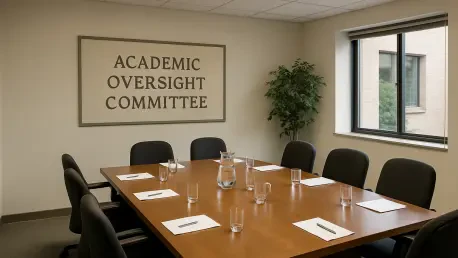

A fundamental question regarding the scope of a school board’s authority took center stage as the Augusta County School Board narrowly voted down a proposal to create a new committee dedicated solely to academic oversight. The 4-3 decision highlighted a sharp philosophical divide among members, pitting a desire for deeper, more direct involvement in student achievement against the long-held principle that the board should govern from a distance, leaving day-to-day educational matters to professional staff. This debate, sparked by a new member’s initiative, delved into the essential duties of elected officials, questioning where the line between diligent oversight and administrative overreach truly lies. The motion’s failure underscored the prevailing sentiment that while student success is the ultimate goal, the methods for achieving it should remain firmly in the hands of the district’s educators and administrators, a stance that ultimately preserved the current governance structure despite a compelling push for change.
A Push for Deeper Academic Insight
The initiative for the new academic committee was championed by Sharon Griffin, a newly elected board member whose perspective is shaped by 40 years as a teacher and a doctorate in educational leadership. Griffin argued passionately that the board’s primary responsibility is academic success and that a dedicated committee was essential to gain “a handle on it.” She envisioned a body that could move beyond surface-level test score data to develop a more complex and nuanced understanding of student performance across the district. Her proposal was not about dictating curriculum but about creating a formal structure for in-depth analysis and inquiry. Supporting this view, fellow new member Daniel Whitmire framed the committee as a vital tool for assisting the new superintendent, Kelly Troxell, in establishing clear and effective goals. He asserted that such a function was a fundamental duty of the board, representing proactive governance rather than micromanagement. Together, they presented the committee as a mechanism for more informed, data-driven decision-making that would ultimately strengthen the partnership between the board and the administration.
Concerns Over Governance and Micromanagement
In the end, a majority of the board viewed the proposed committee as an unnecessary and potentially disruptive intrusion into the administrative domain. Board Chairman David Shiflett, who voted against the measure, articulated the core of the opposition’s argument by drawing a firm line between the board’s duties and the staff’s responsibilities. “Our role is oversight, not management,” he stated, characterizing the proposal as “meddling” in the work of the division’s professional educators. This perspective was reinforced by member John Ward, who expressed his full confidence in the district’s “trained professionals” to manage academic matters effectively. The final vote saw Shiflett and Ward joined by Tim Swortzel and John Ocheltree in opposition, forming the narrow majority that defeated the motion. The decision was made during the same meeting where Superintendent Troxell announced that four county high schools—Buffalo Gap, Riverheads, Fort Defiance, and Stuarts Draft—had earned a “distinguished” designation from the Virginia Department of Education, a piece of positive news that may have bolstered the opposition’s case that the current system of administrative-led academic management was already proving successful.