
In the dynamic world of education, few voices navigate the intersection of pedagogy and technology with the clarity of Camille Faivre. An expert in education management, Camille has been at the forefront of helping institutions adapt to a post-pandemic reality, specializing in the thoughtful development and implementation of e-learning programs. As artificial intelligence moves from a classroom curiosity to a core component of the educational ecosystem, her insights are more critical than ever.
This conversation explores the most pressing issues surrounding AI’s integration into our schools. We delve into how AI promises to revolutionize the teacher’s role by automating administrative burdens, freeing them to focus on vital human connections. We also confront the significant challenges of ensuring this technological wave lifts all students equally, addressing concerns about equity, access, and the urgent need for robust professional development. The discussion navigates the nuances of advanced AI, such as retrieval-augmented generation (RAG) and its role in combating misinformation, and envisions a future where voice AI makes assessment a seamless, natural part of learning. Finally, we examine the new skills required for this era—teaching students to “command” rather than “demand” from AI—and the critical importance of establishing clear governance to manage risks like “Shadow AI” while fostering responsible innovation.
Several experts, including David Everson, predict AI will free teachers from administrative burdens. Beyond lesson planning, what specific, time-consuming tasks will be automated, and what metrics can schools use to measure how this reclaimed time is reinvested into meaningful student connections?
It’s a vision that resonates deeply with educators, and for good reason. We’re not just talking about generating a single lesson plan. Imagine an AI-powered assistant that digests a classroom’s latest assessment data overnight. By morning, it has not only streamlined lesson plans but has also prepared personalized recommendations for individual students and small groups who are struggling with specific concepts. It’s about automating the entire feedback loop. Tasks like administering and analyzing reading assessments, which can consume hours, will become instantaneous, offering real-time insights that guide instruction. We’ll see AI taking on the heavy lift of scoring free-response homework, providing immediate, individualized feedback to students while flagging broader patterns for the teacher.
Measuring the impact is the crucial next step. We can’t just assume freed time equals better outcomes. Schools should start with quantitative metrics, like conducting time audits to see the percentage of a teacher’s day shifting from administrative work to direct student interaction. But the real story is in the qualitative data. This means implementing regular surveys for both teachers and students that gauge the quality of their interactions and feelings of classroom connection. It means administrators conducting classroom observations focused specifically on the depth of student-teacher engagement. When we hear that 64 percent of parents want AI to help teachers build stronger connections, that becomes our core metric: Are we fostering an environment where students feel more seen, heard, and supported? That’s the ultimate return on investment.
Scott Anderberg and Michelle Stie both warn about potential inequities, from fragmented adoption to a widening STEM gap. What practical, step-by-step strategies can districts implement to ensure all students have equitable access to AI tools and teachers receive the necessary professional development?
The threat of creating a two-tiered system is very real and must be addressed proactively. A fragmented, school-by-school approach is a recipe for inequity. The first step for any district is to move toward centralized strategy development and clear policy creation. This isn’t about stifling innovation; it’s about setting a baseline for quality and access. This policy must explicitly prioritize equitable access to AI resources, ensuring that the most powerful tools aren’t just concentrated in affluent schools or specialized programs. It means auditing current technology distribution and making conscious investments to close gaps.
The second, and perhaps most critical, step is committing to comprehensive, ongoing professional development. We have a widening skills gap where students are often adapting to these tools faster than their instructors. A one-off training day won’t work. Districts need to build sustained programs that equip teachers with not only the technical skills to use AI but also the pedagogical strategies to integrate it effectively and ethically. This training must focus on fostering inclusive environments where every student, regardless of background, feels empowered to engage with these technologies. Finally, districts must establish a process for vetting and approving AI tools, ensuring they meet rigorous standards for privacy, security, and educational value. This creates a safe, curated ecosystem for teachers to explore, preventing them from having to navigate the Wild West of AI apps on their own and ensuring the tools used in every classroom are both powerful and safe.
Paul Gazzolo mentions retrieval-augmented generation (RAG) as key to reducing misinformation. Can you explain how a teacher could use a RAG-based tool versus a standard LLM for a history project, and what guardrails are needed to ensure intellectual property integrity is maintained?
This distinction is fundamental to the responsible use of AI in education. Let’s imagine a student is working on a history project about the causes of the American Revolution. If they use a standard large language model, the AI will pull information from its vast training data, which includes the entire public internet—blogs, forums, unverified articles, everything. It might generate a plausible-sounding paragraph that unfortunately conflates facts or cites a debunked theory. The student has no easy way to verify the source or its credibility.
Now, picture that same student using a RAG-based tool provided by the school. This tool has been specifically grounded in an authoritative, curated database—perhaps the university’s digital archives, a collection of peer-reviewed historical journals, and digitized primary source documents. When the student asks the same question, the RAG tool retrieves information directly from these trusted sources and then uses its generative capabilities to synthesize an answer. The output is not only more accurate but can also provide direct citations, pointing the student back to the original, verifiable content. The beauty of this model is that the primary guardrail for intellectual property is built into its very architecture. By operating within a closed ecosystem of vetted content, it inherently respects the integrity of that material and avoids the IP pitfalls of scraping the public web. It shifts AI from a “black box” of answers to a transparent partner in the research journey.
Kristen Huff envisions voice AI transforming assessment into a seamless part of learning. Could you walk us through what this might look like in an early literacy classroom and what challenges schools must overcome to shift from traditional testing to these more authentic evaluations?
It’s a truly exciting vision, especially for our youngest learners where traditional testing can be so unnatural and intimidating. Picture a first-grade classroom during reading time. A child is sitting in a quiet corner with a tablet, reading a story aloud. As they read, a voice AI isn’t just listening; it’s actively assessing. If the child stumbles on a word, the AI might offer gentle, immediate corrective feedback on the pronunciation. It’s not an interruption; it’s a natural part of the practice. Simultaneously, the technology is logging valuable data in the background for the teacher—tracking fluency rates, identifying specific phonetic skill gaps, and noting patterns of difficulty.
At the end of the day, the teacher doesn’t have a stack of tests to grade. Instead, they have a dashboard that provides a rich, holistic view of each child’s progress. They can see at a glance which students are struggling with long vowel sounds or which ones are ready for more complex texts. Assessment becomes an invisible, ongoing conversation between the student, the technology, and the teacher. The challenges, however, are significant. First, the technology must be incredibly sophisticated and rigorously validated by research to ensure its assessments are accurate and unbiased. Second, there’s a huge cultural shift required. We have to move away from the ingrained model of intermittent, high-stakes testing and build trust in these more continuous, authentic forms of evaluation. Finally, this requires substantial investment in teacher training, not just on how to use the tool, but on how to interpret this new stream of rich data to truly personalize instruction.
Eric Wang suggests students will move from “demanding” AI to “commanding” it in a “co-authorship” model. What would this look like in a high school writing assignment, and what key changes would teachers need to make to their rubrics to evaluate this new skill effectively?
This is a critical evolution in how we approach AI literacy. The “demanding” model is a student simply typing, “Write an essay about the themes in The Great Gatsby.” The “commanding” model is far more sophisticated and engaged. In a high school writing assignment, this co-authorship would be transparent. A student might start by writing their own thesis and outlining their core arguments. Then, they might use an AI tool to brainstorm potential counterarguments or to expand on a specific point with additional evidence, all while critically evaluating the AI’s suggestions. In their final submission, they would include a disclosure statement, detailing precisely how and when AI was used—for example, “I used GenAI to refine the transitions between paragraphs and to check my final draft for clarity and tone.”
This fundamentally changes how we grade. A traditional rubric focused solely on the final written product becomes obsolete. Teachers will need to develop new rubrics that evaluate the entire process. A key criterion would be “Strategic Use of AI,” assessing whether the student leveraged the technology to enhance their original thinking rather than replace it. Another would be “Process Transparency and Ethics,” grading the student’s honesty and thoughtfulness in their disclosure. The focus of assessment shifts from merely the quality of the final text to the student’s ability to command technology, think critically about its outputs, and maintain ownership of the creative process from start to finish. We’d be grading a new, essential 21st-century skill.
Justina Nixon-Saintil raises the alarm on “Shadow AI.” What are the top three components a district’s AI policy must include for 2025 to address the use of unapproved applications while still fostering responsible experimentation among students and staff?
“Shadow AI” is one of the biggest unseen risks districts face, and a clear policy for 2025 is non-negotiable. The first essential component must be a robust data privacy and security protocol. This policy needs to explicitly define what constitutes sensitive information—student PII, district financial data, proprietary curriculum—and strictly prohibit its input into any non-approved, public-facing AI application. This creates a clear red line that protects the institution from potentially catastrophic data breaches.
Second, districts can’t just say “no.” They need to provide a “yes.” This means creating a ‘walled garden’ of district-vetted and approved AI tools. This curated list of applications gives students and teachers a safe and powerful sandbox to experiment in. By providing access to tools that have already been evaluated for educational value and data security, the district fosters innovation while minimizing risk. It channels the natural curiosity of users toward safe and productive avenues.
Finally, policy is meaningless without education. The third component is mandatory upskilling for everyone—students, educators, and administrators—with a specific focus on AI ethics and data management. This training must go beyond how to use the tools; it has to teach them why using unapproved applications is dangerous, how to identify potential risks, and how to operate as responsible digital citizens. If we invest in training the entire educational workforce now, they will be prepared to responsibly develop and use AI in a way that is both powerful and trustworthy.
What is your forecast for the single most transformative application of AI in education that will become mainstream by the end of 2025?
While there are many exciting advancements on the horizon, I believe the single most transformative application to become mainstream by the end of 2025 will be the rise of the integrated “AI Teacher’s Assistant.” This won’t be a single product but rather a suite of AI-driven tools seamlessly woven into the daily workflow of educators. It will be the application that finally begins to solve the teacher burnout and workload crisis in a tangible way.
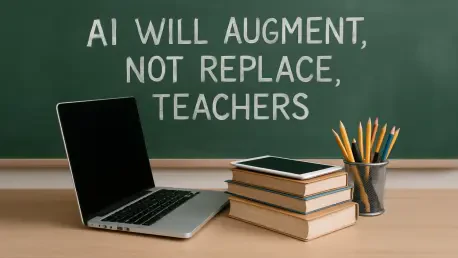
This AI assistant will act as a hyper-personalized aide, automating the most time-consuming administrative tasks. It will score homework, analyze student writing for common errors, and provide real-time, individualized feedback. It will automate the creation of quizzes and practice materials tailored to specific skill gaps identified in recent assessments. Crucially, it will digest mountains of performance data and present it to teachers in a clear, actionable format, allowing them to see at a glance who needs help and where. The true transformation isn’t the technology itself, but what it unlocks. By offloading these burdens, it will give teachers back their most valuable resource: time. This reclaimed time will be reinvested into what matters most—fostering deep relationships with students, facilitating creative and collaborative projects, and providing the irreplaceable human connection that lies at the heart of all meaningful learning. This is where AI’s promise becomes reality, not by replacing teachers, but by empowering them to be more present, insightful, and human than ever before.